Custom Vitamin Gummy Formulation begins with a deceptively simple question: can each gummy deliver its promised nutrients consistently, taste pleasant, and remain stable on the shelf? The Council for Responsible Nutrition’s 2023 Consumer Survey found that 74% of U.S. adults use dietary supplements. That broad demand raises the bar for clear labeling and dependable quality. A gummy should do more than look bright in a clear jar. Its serving size, texture, and nutrient content all matter.
The details are practical. Vitamin C can taste sharp; minerals may leave a lingering note. Heat, moisture, and ingredient interactions can affect stability. Formulators therefore test active ingredients, sweeteners, pectin or gelatin systems, flavor balance, and packaging under realistic storage conditions. They also verify that the finished product matches its label. Small batches can reveal problems early. Useful, but not perfect. More testing may still uncover surprises.
Dr. Andrea Wong, a supplement-science and regulatory affairs expert at the Council for Responsible Nutrition, represents an important industry perspective: formulation decisions should be grounded in evidence and product quality. This introduction does not present a verbatim quotation from her. Instead, it applies that quality-first principle to gummy design. The seven tips that follow will examine ingredient selection, dose accuracy, taste masking, texture, stability, manufacturing controls, and label review. A successful Custom Vitamin Gummy Formulation balances consumer appeal with measurable performance. Sweetness alone is not proof of quality. Nor is an attractive color. Each choice needs a reason, and each finished batch needs checks.
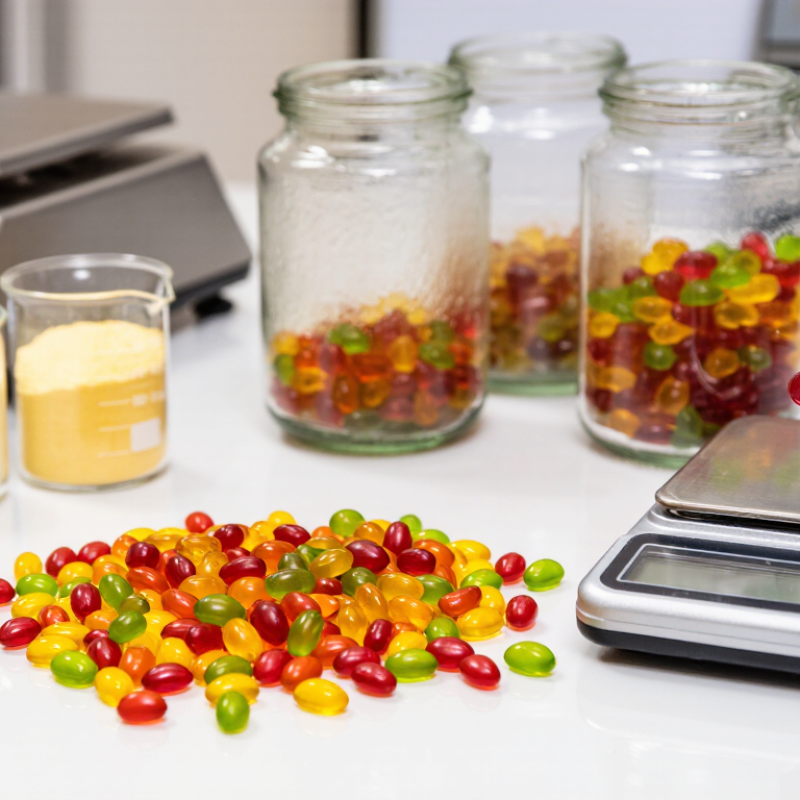
Set each gummy serving’s nutrient targets against the Daily Values (DVs) in FDA regulation 21 CFR 101.9. For adults and children age four and older, the vitamin C DV is 90 mg. A serving with 45 mg therefore provides 50% DV. The basic calculation is the nutrient amount per serving divided by its DV, multiplied by 100. Check units carefully. Milligrams and micrograms are easy to confuse.
Decide how many gummies make one serving before locking the formula. If two gummies provide the target, the label should show the nutrients in those two gummies, not in one. For supplement products, check the applicable Supplement Facts requirements as well; DVs are reference points, not individual health recommendations. A neat percentage can still hide a poor assumption. Consider the intended age group and whether the serving is practical to chew and swallow.
Then test the finished gummies, not just the powder blend. Heat, moisture, and storage can affect nutrient levels, while flavoring may complicate taste at higher doses. Keep records of ingredient specifications and test results, and review label calculations against the final serving size. Small details matter. I would revisit the target if the gummy becomes too large or the flavor turns sharply sour; a spreadsheet alone cannot settle that.
Under 21 CFR Part 111, choosing a vitamin form is a formulation decision, while quality controls must support the finished supplement’s specifications. Define specifications for identity, purity, strength, composition, and relevant contaminants. Keep supplier records, verify component identity, and document quality-control review. A certificate alone may not answer every question. Match each form to the gummy’s acidity, moisture, heat exposure, and serving size. Small details matter.
Tip 1: Compare forms using evidence and production behavior, not label appeal alone. Check whether a mineral form leaves a bitter or metallic note after cooking. Confirm potency after processing and during stability testing. Tip 2: Review supplier specifications and identity information, then determine whether additional testing is appropriate. Keep the rationale on file. Simple, but often missed.
Tip 3: Test interactions in the actual gummy base. Vitamins, colors, flavors, and moisture can affect appearance or potency over time. Use batch records and in-process checks to document controlled mixing, depositing, and packaging. Retest finished samples at planned intervals. Real-world storage can be messy. A neat pilot batch does not prove shelf life. Part 111 supports documented controls; sound formulation judgment and product-specific testing remain essential.
| Tip | Formulation decision | Examples of vitamin forms | Gummy-specific considerations | GMP documentation and quality checks |
|---|---|---|---|---|
| 1. Define the target and serving first | Set the intended vitamin amounts per serving, serving size, target consumer, and product specifications before selecting ingredient forms. | Form selection depends on the nutrient and product requirements; no single form is best for every gummy. | Account for gummy piece weight, flavor, color, texture, and the amount of each ingredient the recipe can accommodate. | Establish appropriate component, in-process, and finished-product specifications. Keep the formulation and production instructions in the master manufacturing record and document each batch as required by Part 111. |
| 2. Compare forms for the specific vitamin | Compare identity, concentration, physical properties, intended use, and supplier data for candidate forms. | Examples include vitamin D2 (ergocalciferol) or D3 (cholecalciferol); vitamin C (ascorbic acid or a suitable ascorbate); and vitamin B12 (cyanocobalamin or methylcobalamin). | Check solubility or dispersibility, taste, color, and compatibility with the gummy base. Ingredient forms may behave differently during mixing and storage. | Set component specifications that address identity and relevant quality attributes. Part 111 requires appropriate component testing or examination; any applicable supplier-qualification approach must meet the regulation’s conditions. |
| 3. Review stability in the actual gummy process | Assess the selected form under the product’s processing and proposed shelf-life conditions rather than relying only on ingredient descriptions. | Evaluate each vitamin individually; for example, vitamin A may be supplied as retinyl acetate, retinyl palmitate, or beta-carotene, depending on the formulation and product requirements. | Heat, moisture, oxygen, light, pH, and interactions with other ingredients can affect product quality. Confirm relevant risks with product-specific development and stability work. | Define scientifically appropriate finished-product specifications and testing or examination procedures. Do not treat an assumed processing loss or an unverified overage as a substitute for supporting data. |
| 4. Check interactions with the gummy base | Test the vitamin ingredient with the selected gelling system, sweeteners, acids, flavors, colors, and other nutrients. | Fat-soluble vitamins such as A, D, E, and K may require a formulation approach that supports uniform distribution in the chosen base. | Assess dispersion, settling, clumping, color or flavor changes, and effects on texture. Select a carrier or premix only after confirming that it is suitable for the recipe and declared product. | Document ingredient addition order, mixing conditions, and other controls needed to meet established in-process and finished-product specifications. |
| 5. Plan for uniformity in every piece | Choose an ingredient form and manufacturing method that can deliver a consistent distribution throughout the batch. | Powdered, liquid, or premix ingredients may be considered where appropriate, but the form alone does not establish uniformity. | Review particle size or dispersion, batch size, mixing time, hold time, and depositing conditions. Validate or otherwise support the selected process controls as appropriate to the product. | Identify relevant in-process controls and acceptance criteria. Batch production records should capture the actual manufacturing steps, including applicable measurements and results. |
| 6. Match the specification to the ingredient and finished product | Specify the vitamin’s identity and other quality attributes that are appropriate for the component and intended finished product. | For vitamin E, for example, distinguish the specific form and source used rather than relying on a generic “vitamin E” description in internal component records. | Consider whether the analytical method is suitable for the gummy matrix and whether sampling represents the batch. | Under 21 CFR Part 111, specifications and associated testing or examination must be appropriate to the applicable components, in-process materials, and finished product. Retain records supporting results and disposition decisions. |
| 7. Confirm label and serving alignment | Verify that the selected form, formulation, serving size, and declared nutrient amounts are consistent with the product’s intended labeling. | Use the applicable nutrient name and form information required for the product’s labeling; review source and form details where they affect the declaration. | Check that the serving can be delivered reliably as the labeled number and size of gummies, and that stability data support the product through its proposed shelf life. | Part 111 addresses manufacturing and quality-control requirements; it does not prescribe one universally preferred vitamin form. Review labeling separately against applicable FDA labeling requirements. |
Regulatory note: 21 CFR Part 111 establishes current good manufacturing practice requirements for dietary supplements, including requirements for specifications, production and process controls, quality control, and records. The suitability of a vitamin form and the specifications for a particular gummy should be determined for the product and supported by appropriate documentation and testing.
Choosing pectin or gelatin changes the gummy’s bite, heat response, and processing needs. Pectin can create a firm, clean-cut texture, but its performance depends on the pectin type, soluble solids, and acidity. High-methoxyl pectin generally needs an acidic, sugar-rich system; low-methoxyl pectin relies on calcium. Gelatin usually gives a springier chew and softens with warmth. Neither is automatically better.
Treat pH as a measured process variable, not a flavor adjustment. Calibrate the meter, use the same sampling method each time, and record readings at a consistent temperature. Add acid gradually in small trials, since vitamin minerals and other ingredients may change the batch’s buffering behavior. A universal pH target can mislead; set a range suited to the chosen gelling agent and ingredient stability. Small differences matter.
Texture needs equally practical checks. Cast test pieces at the intended size, allow them to set and dry consistently, then compare firmness, chew, stickiness, and surface moisture. Use the same simple compression test for each trial, even if it is not perfect. Retest samples after realistic storage conditions, because a gummy that feels right on day one may toughen or sweat later. Keep batch notes; memory is unreliable.
For a vitamin gummy, water activity is a practical control point, not a moisture percentage. It measures how much water microorganisms can use. FDA’s technical guidance on water activity identifies 0.60 as the lower limit for microbial growth. Beuchat’s review in the Journal of Food Protection (1981) notes that some unusually tolerant yeasts and molds approach this boundary. Set a validated target below 0.60, with a safety margin suited to the formula. A target of 0.55 may be a useful starting point for trials, not a universal guarantee. Low water activity is no magic shield. Sanitation and sound packaging still matter.
Test finished gummies after moisture has equilibrated, using a calibrated water-activity meter. Sample pieces from different parts of the batch; a glossy edge and a dense center may not behave alike. Record individual readings, not just the average. A batch average of 0.54 could conceal a wetter piece. Validate the target across multiple production runs and through shelf-life testing. Sugar, acids, and humectants can shift both water activity and texture, so check for a tough bite or surface stickiness too. Revisit the target when the recipe or package changes. That step is easy to overlook.
A gummy can look consistent while its vitamin content drifts. Heat, moisture, acidity, and long storage may affect sensitive nutrients, so test representative batches rather than relying on the recipe alone. Small details matter. Check potency at release and during stability studies in the finished package, under realistic storage conditions. Use validated analytical methods and keep records linking results to batch numbers, dates, and serving sizes. If results vary, adjust the formula or process before making label promises. A beautiful color is not evidence of potency.
For Supplement Facts, apply 21 CFR 101.36 to the finished product, not an early draft. Confirm the serving size, dietary ingredient names, amounts per serving, units, and percent Daily Values where established. Include required components in the correct format, and verify that declared amounts remain supportable through the product’s shelf life. Keep other ingredients, such as sweeteners and pectin, in the appropriate ingredient statement. Review the label against current FDA rules and the actual formula. That is not enough. A calculation can miss losses during cooking or filling, and a stability result from one batch may not represent every batch. Document the reasoning, investigate unexpected variation, and revise the label or formulation when the evidence calls for it.
Selected U.S. adult Daily Values for nutrients commonly used in gummies. Values are nutrient-specific reference amounts, not recommended gummy serving sizes.
Formulation note: Check each nutrient’s potency at the end of shelf life, account for processing and storage losses, and verify the finished product with appropriate testing. Under 21 CFR 101.36, supplement labels generally declare the amount per serving and the applicable percent Daily Value; use the nutrient-specific units and rounding rules. Bar lengths are not a comparison of biological potency.
Pectin can make a firm, clean-cut gummy. Gelatin usually creates a springier chew and softens with warmth. Neither is always better.
Calibrate the meter and sample at a consistent temperature. Add acid gradually, since ingredients can change the mixture’s buffering behavior. Small differences matter.
No. The suitable range depends on the gelling agent and ingredient stability. A universal target can mislead.
Cast pieces at the intended size and dry them consistently. Compare firmness, chew, stickiness, and surface moisture using the same compression test. It is crude, but useful.
Texture can change over time. A gummy that feels right on day one may toughen or develop surface moisture later.
Test representative finished batches with validated analytical methods. Check potency at release and during stability studies. Appearance alone proves little.
Review serving size, ingredient names, amounts, units, and established Daily Values against the finished formula. Check current requirements under 21 CFR 101.36.
Record test results, batch numbers, dates, and serving sizes. Investigate unexpected changes and revise the formula or label when evidence requires it. Memory is unreliable.
Custom Vitamin Gummy Formulation starts with clear nutrient goals for each serving, using FDA Daily Values as a reference when planning amounts and preparing the product’s intended use. Select suitable vitamin forms and establish consistent ingredient-handling, manufacturing, and quality procedures in line with dietary supplement GMP requirements. Then choose pectin or gelatin based on the desired texture, and test how the formula’s pH affects taste, firmness, and product performance.
A reliable formula also needs a validated water-activity target below 0.60 to help limit microbial growth, alongside appropriate manufacturing controls. Test finished gummies for nutrient potency and stability over their intended shelf life, and ensure the Supplement Facts panel accurately reflects the formula and serving size under applicable labeling requirements. Documenting these decisions and results helps create a gummy that is consistent, stable, and clearly labeled.